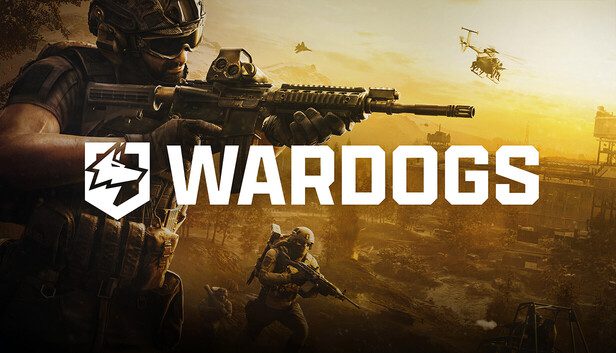
WARDOGS Best Settings need to hold up in the middle of a 100-player fight, not just produce a good frame-rate number while you stand at an empty spawn. Vehicles, destruction, smoke and dozens of players can turn a smooth-looking preset into a stuttering mess around the Control Zone.
The official minimum target already assumes upscaling at 1080p Low, while recommended hardware targets 1440p Medium natively or 4K Medium with upscaling. WARDOGS Best Settings should therefore protect visibility first and cut expensive effects that add little during actual combat.
WARDOGS Best Settings: keep view distance useful
Large sightlines are part of the game, so view distance is one of the last settings worth crushing purely for FPS. Losing the ability to read movement on a road or hillside can cost more than the few frames saved.
Keep it high enough to spot distant infantry and vehicles, then reclaim performance from lighting, reflections and post-processing before sacrificing battlefield awareness.
Lower shadows, reflections and heavy lighting
Shadows and reflections can be expensive during busy scenes without giving much competitive information. Lower values are a sensible first step when the GPU is struggling.
Global lighting options are another place to look if large fights create unstable frame times. WARDOGS Best Settings are about reducing the effects that become costly exactly when the screen is already full of smoke, vehicles and debris.
Disable blur and cinematic clutter
Motion blur, depth of field, bloom and similar effects can make fast movement harder to read. Turning them down or off usually improves clarity as well as removing some rendering work.
This is especially useful around a crowded objective. The game already creates natural visual chaos, so extra blur rarely helps a player identify targets.
Match texture quality to VRAM
Texture quality often depends more on available VRAM than raw GPU speed. Keep textures reasonably high if the card has memory headroom, then lower them if stuttering or memory pressure appears.
Do not assume every option belongs on Low. WARDOGS Best Settings should target the actual bottleneck rather than making the game uglier without measurable gain.
Use DLSS or FSR when the GPU needs help
Upscaling is part of BULKHEAD’s published performance targets, including the minimum-spec 1080p target. Start with a quality-focused mode and only move toward more aggressive scaling if the GPU still cannot hold the frame rate you want.
Test it in a real Control Zone fight. An upscaler that looks perfect at base but shimmers badly through smoke or distant foliage may need a different quality level.
Cap FPS around a target the PC can sustain
A stable 90 FPS through heavy fights is more useful than 150 FPS at spawn followed by large drops when combat begins. A sensible cap can improve consistency and reduce the feeling of constant frame-time swings.
Use the display refresh rate and the lowest performance you see in real matches to choose the target. WARDOGS Best Settings should be built around consistency, not the highest screenshot number.
Test changes in the same kind of fight
Change one graphics group at a time, then compare performance in a similarly crowded match. If GPU usage is pinned, resolution and heavy effects are sensible targets; if GPU usage falls during frame-rate drops, CPU load may be the larger problem.
That repeatable test keeps WARDOGS Best Settings grounded in what your machine is actually doing instead of turning every option to Low and hoping.
WARDOGS Best Settings for CPU-heavy fights
WARDOGS Best Settings cannot solve every frame drop through graphics changes because 100-player battles can also put pressure on the CPU. If GPU usage falls while the frame rate collapses around the Control Zone, lowering textures or resolution may do very little.
WARDOGS Best Settings should target the bottleneck you can actually see. GPU-bound systems benefit more from resolution, upscaling and lighting changes, while CPU-limited systems need realistic frame-rate expectations and fewer heavy background applications.
THE CLICK
More WARDOGS guides
For current official information, see the official WARDOGS information.