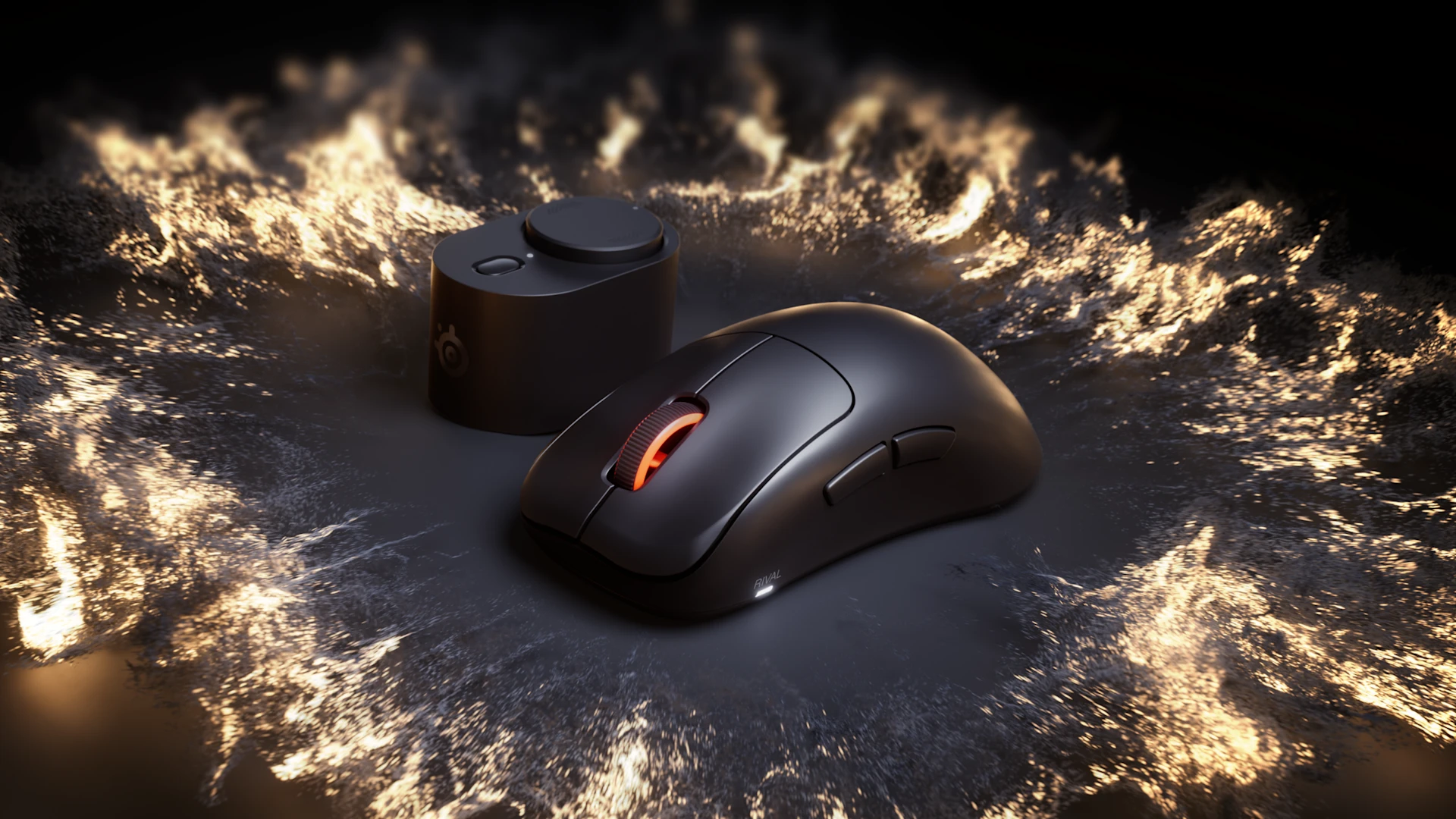
SteelSeries Rival Pro review expectations are high when a gaming mouse costs £169.99, and SteelSeries has at least tried to earn that price rather than simply attaching it to a familiar shape. The Rival Pro is exceptionally light, built around a comfortable right-handed body, and introduces Ultra Wideband wireless alongside a clever two-battery charging system. On paper it sounds like the sort of flagship mouse designed to make everything else feel a generation behind.
It does not quite manage that, but it gets closer than the headline 8K polling figure suggests. The best thing about the Rival Pro is not that it can report eight thousand times per second. It is that SteelSeries has taken several everyday annoyances of wireless gaming mice and genuinely improved them. The connection is impressively robust, the battery system is brilliantly convenient and the 53g ergonomic shell gives the mouse a character of its own. The compromises are just as important, especially the lack of a normal wired fallback.
SteelSeries Rival Pro review specifications
The specification sheet is suitably excessive for a flagship mouse, but most of it fades into the background once you look at how the Rival Pro is actually meant to be used. The TrueMove 42K Pro sensor reaches 42,000 DPI, polling goes as high as 8,000Hz, and the full-size ergonomic shell weighs about 53g. SteelSeries includes two rechargeable batteries, with one powering the mouse while the other sits in the receiver base charging.
| Specification | SteelSeries Rival Pro |
| Shape | Right-handed ergonomic |
| Weight | Approximately 53g |
| Sensor | TrueMove 42K Pro |
| Maximum DPI | 42,000 DPI |
| Maximum polling | 8,000Hz |
| Wireless | Ultra Wideband |
| Battery | Two removable rechargeable batteries |
| Claimed battery life | Up to 60 hours each at 1K, 16 hours each at 8K |
| Normal wired mouse mode | No |
| UK price | £169.99 |
It feels like a proper mouse, just without the weight
The nicest surprise is how little the Rival Pro feels like an ultralight experiment. There is no hollow, cut-away shell and no sense that comfort was sacrificed to reach an impressive number on the box. It has a fuller ergonomic profile that settles naturally into the hand, particularly for palm grip and a relaxed claw grip, yet it still moves with almost no effort.
That combination gives the SteelSeries Rival Pro review its strongest positive note. Plenty of lightweight gaming mice are fast, but some achieve that speed by becoming flatter, smaller or less supportive. The Rival Pro feels much more substantial than 53g suggests. The main optical clicks are sharp without feeling brittle, the side buttons fall into sensible positions and the weight distribution feels balanced rather than nose-heavy.
The black coating is less impressive. Fingerprints and skin oils show up more readily than they should on something this expensive, and the scroll wheel is likely to divide opinion. It is perfectly usable, but the individual steps are not as crisp or deliberate as the best competitive wheels. That is hardly a deal breaker, though it is one of those details that becomes harder to ignore when the price is pushing £170.
SteelSeries Rival Pro review: UWB is the real technical upgrade
Ultra Wideband sounds like another piece of wireless marketing until you consider how crowded a modern gaming desk has become. Headsets, keyboards, phones, controllers and Wi-Fi devices are all competing for space, usually around the same familiar frequencies. The Rival Pro moves its connection into UWB spectrum instead, and that gives SteelSeries a genuinely different approach to wireless reliability.
The important point is that UWB does not make a good 2.4GHz mouse suddenly feel slow. That would be overselling it. What it does is make the connection feel exceptionally dependable in the sort of environment where wireless interference can become messy. Across the testing already carried out on the Rival Pro, stability has been one of the most consistent strengths, and that is much more convincing than a vague claim that wireless somehow feels faster.
For a SteelSeries Rival Pro review, that distinction matters. UWB is valuable because it removes doubt, not because the cursor suddenly travels across the screen differently. If your desk is already full of wireless hardware, this is one of the few flagship mouse features that actually feels like a meaningful engineering change rather than another specification bump.
SteelSeries Rival Pro review: 8K polling works, but it is not the reason to buy one
The 8,000Hz polling mode is technically impressive and far less persuasive in everyday use. At its best, on a high refresh display with a very fast competitive game, higher polling can make tracking and rapid movement marginally smoother. Counter-Strike 2, Valorant and Fortnite are exactly the sort of games where it has the best chance of mattering.
Even there, the difference from a good 1,000Hz implementation is subtle. The SteelSeries Rival Pro review verdict on 8K is simple: use it if your system is fast enough and you enjoy squeezing out every last bit of responsiveness, but do not buy the mouse because of it. A strong 1K or 2K setup is already excellent for the vast majority of players, and the extra polling comes with a noticeable battery penalty.
SteelSeries at least handles that trade-off intelligently. SuperSync can keep click reporting high while the sensor runs at a lower polling rate, which is a much more sensible way to use the hardware than leaving everything pinned at the maximum. If you want to understand where polling fits into the wider latency chain, our low latency gaming explained guide goes into the rest of the system, while our gaming mice with minimal input lag guide gives the Rival Pro some useful context.
SteelSeries Rival Pro review: the battery system is better than the headline feature
This is the part of the Rival Pro that is easiest to love. One battery sits inside the mouse and the spare charges in the receiver base. When the active one runs low, swap them over and carry on. There is no evening spent using an awkward charging cable and no real need to think about battery life as long as the spare goes back into the charger.
SteelSeries claims up to 60 hours from each battery at 1K polling and up to 16 hours at 8K. Those are manufacturer figures, so real use will vary, but the clever part is that raw endurance matters less when another battery is always waiting. The SteelSeries Rival Pro review case for the Infinite Power System is much stronger than the case for 8K polling because it improves the experience every single time the battery gets low.
It is one of those features that sounds almost boring until you live with the alternative. Other flagship mice can last longer on one charge, but the Rival Pro makes the charging process practically disappear. That feels more useful than another twenty hours added to an internal cell.
SteelSeries Rival Pro review: the wired limitation is hard to ignore
There is one decision that feels unnecessarily stubborn. The Rival Pro does not have a normal wired mouse mode. The cable connects to the base, not directly to the mouse, so you cannot simply plug it in and keep playing if the wireless hardware is unavailable.
Most of the time the dual batteries make this irrelevant, but that is not the same as making it a good decision. Travelling becomes less convenient, troubleshooting is less flexible and a failed receiver matters more than it would on a mouse with USB fallback. SteelSeries sells a separate travel dongle, which solves part of the portability problem while also making the dependency more obvious.
That is the biggest reservation in the SteelSeries Rival Pro review. At £169.99, flexibility should be part of the premium experience. The UWB connection is excellent, but excellent wireless should sit alongside a wired safety net rather than replace it entirely.
Software is powerful without becoming the main attraction
SteelSeries GG offers the expected DPI and button remapping controls alongside polling rate, lift-off distance, sensitivity and more specialised sensor adjustments. There is also a browser-based configuration route for simpler changes, which is welcome if you do not want another full desktop utility permanently installed.
The software suits the mouse because it lets enthusiasts dig deep without making those options necessary for everyone else. Most people can set DPI, choose a sensible polling rate, map the side buttons and then forget about it. Fortnite players who use those side buttons for building can pair that with our best Fortnite keybinds guide and Fortnite best settings guide.
SteelSeries Rival Pro review: is it worth £169.99?
The Rival Pro is expensive, and pretending otherwise would make the recommendation meaningless. You can buy superb competitive mice for much less, including models with proven 2.4GHz wireless, excellent sensors and shapes that may suit your hand just as well. Our low-latency gaming keyboard guide, competitive controller guide and gaming headset guide also show how quickly a complete premium setup can become expensive.
What saves the Rival Pro from feeling like an exercise in excess is that two of its expensive ideas are genuinely useful. UWB gives it excellent wireless resilience and the battery system is one of the smartest solutions to charging downtime on any gaming mouse. The 8K mode is a nice extra rather than the star.
SteelSeries Rival Pro review verdict
The SteelSeries Rival Pro review ends in a more positive place than the price initially suggests. This is a very light, very comfortable ergonomic mouse with crisp switches, excellent wireless reliability and a battery system that is genuinely better than plugging a mouse in every few days. It feels like a premium product because of how those pieces work together, not because SteelSeries printed 8K on the box.
It is not flawless. The scroll wheel will not be everyone’s favourite, the black finish shows grime too easily and removing wired operation feels like an unnecessary own goal. Those issues matter more at £169.99, where buyers are entitled to expect almost no compromises.
For current specifications, compatibility and UK product information, see the official SteelSeries Rival Pro page. If you mainly want 8K polling, there are cheaper ways to get it. If you want the combination of an ultralight ergonomic shape, exceptionally robust wireless and a battery setup that practically removes charging from the routine, the Rival Pro is much easier to justify.
That is ultimately what makes the SteelSeries Rival Pro review conclusion work: the cleverest feature is not the one with the biggest number. UWB is impressive, 8K is optional, but the hot-swappable batteries and excellent underlying mouse are what make the Rival Pro feel genuinely different.
Related Articles
- Top 10 Gaming Mice With Minimal Input Lag for Competitive Play
- Low Latency Gaming Explained
- Gaming Keyboards With Minimal Input Lag
- Best Controllers With Minimal Input Lag
- Best Gaming Headsets for Competitive Play
- Fortnite Best Settings for Maximum FPS, Zero Lag and Better Aim
- Best Fortnite Keybinds for Building and Editing
- Modern Warfare 4 PC Graphics Settings