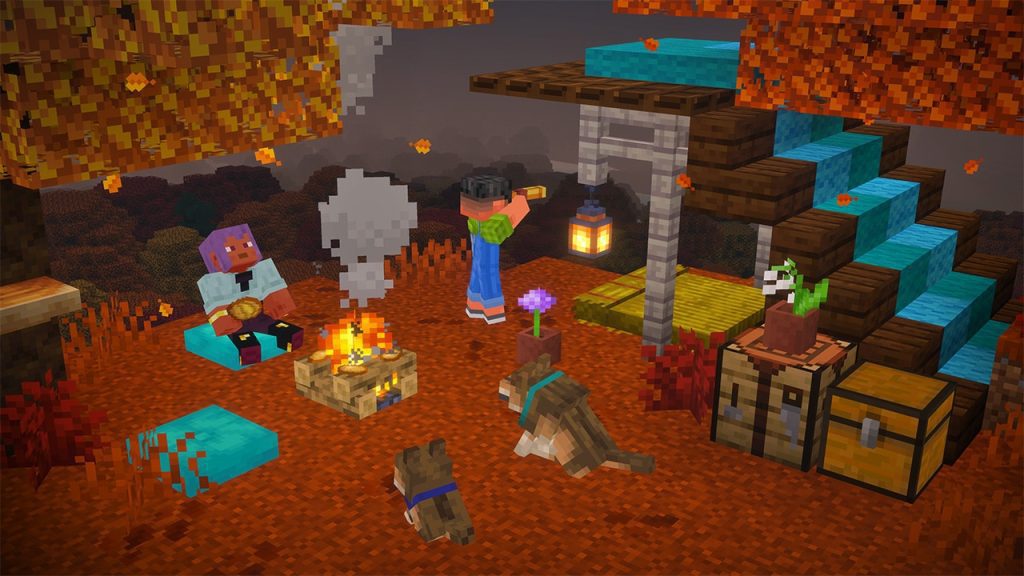
Minecraft Wilderness Bound Update launches September 15 as Minecraft’s third game drop of 2026, adding a new autumnal biome, a broad family of Poplar blocks, biome-specific Abandoned Camps and camping items that are genuinely useful in Survival rather than just decorative.
Minecraft Wilderness Bound Update: quick answer
| New content | What it adds |
|---|---|
| Dappled Forest | Autumn forest found near cold biomes |
| Poplar trees | Red, orange and yellow leaf variants plus full wood set |
| Abandoned Camps | Biome-specific structures with chests, barrels and maps |
| Straw Bed | One-use night skip without changing spawn |
| Cushions | Sit-able blocks in 16 wool colours |
| Building blocks | Wool and concrete stairs/slabs plus related crafting |
The Dappled Forest biome
For Minecraft Wilderness Bound Update, the headline biome generates near cold areas and uses red, orange and yellow Poplar canopies to create a very different forest palette. Red Shrubs, Shelf Mushrooms and fallen Poplar trees add detail at ground level.
Passive mobs including sheep, chickens, cows, pigs, rabbits and foxes can appear there, using cold variants where applicable. A Dappled Forest version of the new Abandoned Camp can also generate inside the biome.
Abandoned Camps and Explorer Maps
For Minecraft Wilderness Bound Update, the new structures appear across a long list of Overworld biomes rather than belonging only to the Dappled Forest. The build changes to suit the biome, and chests or barrels can hold loot.
Later preview changes also added Explorer Maps connected to major destinations and other camp variants, giving the structure a genuine travel loop instead of making it a one-and-done decoration.
Poplar wood and autumn leaves
For Minecraft Wilderness Bound Update, poplar trees arrive with red, orange and yellow leaf variants, each using matching falling-leaf particles. The trunk supplies Poplar logs and the normal family of wood building blocks.
Poplar leaves can drop saplings, and planted saplings can grow the different leaf-colour variants. Wandering Traders are another possible sapling source if you have not reached a Dappled Forest yet.
Straw Beds are made for travel
For Minecraft Wilderness Bound Update, three Hay Bales craft four Straw Beds. Sleeping in one skips the night but does not set your spawn point, making it useful when you are exploring far from home and do not want to overwrite a carefully chosen respawn.
The trade-off is that a Straw Bed is single-use and breaks after sleeping. Trying to use one in the Nether or End also destroys it, so it is not a safe dimension-explosion substitute for a normal bed.
Cushions and new wool blocks
For Minecraft Wilderness Bound Update, three Wool Slabs of the same colour craft a matching Cushion, and players can interact with the placed item to sit on it. There are 16 colour variants to match the normal wool palette.
Wilderness Bound also expands wool with stairs and slabs, while concrete receives stairs and slabs too. That gives builders far more ways to shape colourful roofs, seating, trims and curved-looking details.
Shelf Mushrooms and smaller details
For Minecraft Wilderness Bound Update, shelf Mushrooms grow on Poplar trees and fallen logs. Large versions drop two items, they can be used like other mushrooms in stews, and they have a slight bed-like bounce when stepped on.
Red Shrubs, leaf ambient sounds, biome fog tweaks and the added camp variations make the drop feel broader than a single headline biome, even though it is deliberately smaller than a full annual version overhaul.
Minecraft Wilderness Bound Update: useful checklist
- Update Java and Bedrock before looking for new generation.
- Travel into unexplored chunks in an existing world.
- Bring Hay Bales if you want disposable Straw Beds while exploring.
- Search camps for loot and Explorer Maps before moving on.
The official Minecraft Wilderness Bound announcement is the first-party source to check for live changes affecting Minecraft Wilderness Bound Update.
Java and Bedrock release considerations
Wilderness Bound is shared across Java and Bedrock, but version numbers and rollout mechanics differ. On Java it is tied to the 26.3 release line; Bedrock uses its own build numbering. If friends on different devices do not see it immediately, compare installed versions before assuming a delay.
Back up important worlds before exploring
A normal stable update should preserve existing saves, but a backup is still sensible when a world contains months or years of work. New biomes and structures appear in terrain generated under the new rules, so you do not need to reset the world. Keep the old base, make a backup, then travel beyond the area you already explored.