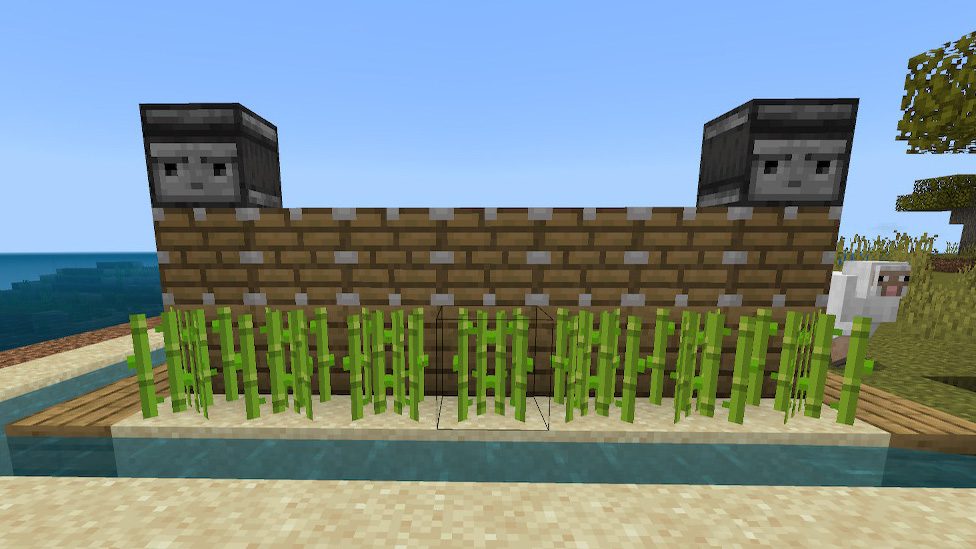
Minecraft Bedrock Sugar Cane Farm is a Bedrock-specific build for players who want automated Sugar Cane production. This guide is written for Bedrock mechanics rather than assuming a Java Edition tutorial will behave the same way, and it puts the shopping list, build checks and common fixes in one place before you start placing hundreds of blocks.
Farm: Sugar Cane Farm
Main output: Sugar Cane
Automation: Automatic
Best for: Paper, rockets and trading
Minecraft Bedrock Sugar Cane Farm quick information
| Farm information | Details |
|---|---|
| Edition | Minecraft Bedrock Edition |
| Difficulty | Easy |
| Build time | 15–20 minutes |
| Main output | Sugar Cane |
| AFK friendly | Yes |
| Nether required | No |
| Redstone | Low |
| Recommended location | Near your base in loaded chunks |
| Key Bedrock consideration | Observer and piston modules work well on Bedrock |
An observer-piston sugar cane farm leaves the bottom cane block planted and automatically breaks new growth above it. Build it in modules so you can expand output later without redesigning the whole farm.
The Minecraft Bedrock Sugar Cane Farm instructions below are written for Bedrock Edition. For official game information and current releases, visit Minecraft.
Materials needed for Minecraft Bedrock Sugar Cane Farm
Gather the full list before building. Where a quantity is marked as approximate, bring extra: terrain, storage choices and the length of collection channels can change the final count.
| Material | Quantity | What it does |
|---|---|---|
| Sugar cane | 8+ | Plants |
| Sand/dirt/mud | 8+ | Planting blocks |
| Water buckets | 2 | Hydrates adjacent cane |
| Pistons | 8+ | Breaks upper cane |
| Observers | 8+ | Detects growth |
| Redstone dust | 8+ | Triggers pistons |
| Hoppers | 2+ | Collection |
| Chest | 1 | Storage |
How to build Minecraft Bedrock Sugar Cane Farm
Step 1 – Lay out one test module
Build a single harvesting module first rather than immediately making a long row. Keep the planting/growth space clear and make sure the collection route has somewhere to send drops.
Step 2 – Install the harvesting mechanism
Place the piston or dispenser so it acts on the resource rather than destroying the permanent base of the farm. Orient observers and dispensers carefully; their facing direction matters.
Step 3 – Connect detection and redstone
Connect the observer, comparator or other detector to the harvesting device. Keep the circuit compact and avoid creating a feedback loop where the piston movement repeatedly retriggers itself.
Step 4 – Add collection and storage
Route drops into hoppers, a hopper minecart or a water stream leading to a chest. Test with ordinary items before waiting for natural growth.
Step 5 – Expand the farm
Copy the working module along the row. Expand storage at the same time so a successful AFK session does not fill one chest and leave items despawning.
Step 6 – Run a survival test
Let the farm operate through several natural growth/harvest cycles. Do not judge it from a single activation: you are checking that the permanent plant/entity remains in place and that collection stays reliable.
How Minecraft Bedrock Sugar Cane Farm works
This farm is intentionally based on ordinary Bedrock mechanics rather than a fragile duplication or zero-tick exploit. That makes the design easier to understand and less likely to disappear after a patch.
| Mechanic | What matters in Bedrock |
|---|---|
| Growth / production | The resource must complete its normal Bedrock growth or production condition before harvest. |
| Detection | Observers and comparators output based on the block state they are watching; facing direction matters. |
| Harvest | The mechanism removes the renewable output while leaving the permanent source intact. |
| Collection | Hoppers, hopper minecarts or water streams must cover the actual drop area. |
| Loaded chunks | Automatic farms only progress normally while the relevant area is being simulated. |
Minecraft Bedrock Sugar Cane Farm not working
If the farm is built but the output is poor or completely stops, work through these checks before tearing it down. Bedrock farms often fail because of spawning distance, village linking, collection direction or a nearby spawn area rather than because the visible structure is wrong.
| Problem | Likely cause | Fix |
|---|---|---|
| Nothing activates | Detector faces the wrong direction or is watching the wrong block | Check the observer face/output side or comparator placement. |
| Machine fires repeatedly | Redstone is feeding back into the detector | Separate the output pulse from moving blocks and remove accidental loops. |
| Items remain on the floor | Collection does not cover the drop area | Move/add hoppers, hopper minecart track or water flow. |
| Farm works only while nearby | Area is no longer simulated | AFK within the correct Bedrock simulation distance. |
| Production source breaks | Harvester hits the base/source | Move the piston/dispenser so only renewable output is harvested. |
Is Minecraft Bedrock Sugar Cane Farm worth building?
Yes if you regularly use Sugar Cane. The strength of this design is that it can start small, prove itself in survival, and then scale by repeating the same working module instead of committing to a giant untested machine.