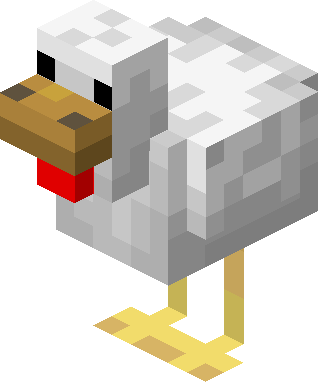
Minecraft Chicken is a passive animal with a very specific role in survival worlds. This guide keeps the useful bits together: where to find it, how it behaves, what it eats or responds to, whether you can tame or breed it, what it drops and what it is actually worth using for.
If you are searching for Minecraft Chicken because one has just appeared in your world — or because you want to farm, collect or avoid it — the fastest answer is this: Chickens fall slowly by flapping their wings and periodically lay Eggs without needing to breed. Its main practical value is renewable Eggs, Feathers and food; easy early-game animal farming.
Where to Find Minecraft Chicken
Minecraft Chicken is found in Many grassy Overworld biomes. The dimension to plan around is Overworld. That matters because travel, lighting, biome checks and structure generation can completely change how quickly you find Chickens.
For a deliberate search, build the trip around the spawn rule rather than wandering randomly. If the mob belongs to a structure, locate the structure first; if it belongs to a biome, search the correct biome family; and if it is player-created or conversion-based, gather the required setup before leaving base. That makes a Chicken hunt far more predictable.
Is Chicken Hostile?
Minecraft Chicken is classified here as Passive. It does not normally hunt the player, although environmental hazards, riders or special defensive behavior can still make an encounter dangerous. Chickens fall slowly by flapping their wings and periodically lay Eggs without needing to breed.
The safest approach is to understand the trigger before interacting. Neutral mobs often become aggressive only after a player action, while passive mobs may still have defensive quirks. Hostile mobs should be treated as a combat encounter from the moment they can path to you.
What Does Chicken Eat?
The relevant food, lure or interaction item for Minecraft Chicken is Seeds, including Wheat, Beetroot, Melon and Pumpkin Seeds. In Minecraft, “what does it eat?” can mean several different things: the item may breed the mob, heal it, tempt it, tame it or simply trigger a unique mechanic. For Chicken, the important interaction is described below rather than assuming every food item works the same way.
Taming: Cannot be tamed, but Seeds tempt and lead Chickens Breeding: Breed two Chickens with suitable Seeds This is the bit to check before you drag a stack of food halfway across the world and discover the mob does not actually use it for the thing you wanted.
Can You Tame Minecraft Chicken?
Minecraft Chicken taming works like this: Cannot be tamed, but Seeds tempt and lead Chickens. If it cannot be tamed, that does not necessarily make it useless. Many Minecraft mobs can still be led, bucketed, saddled, trusted, created, contained or manipulated without ever becoming a conventional pet.
If your aim is simply to keep Chickens at a base, plan the enclosure around the mob’s own movement and survival rules. Aquatic mobs need safe water and air behavior, Nether mobs may react badly to leaving their home dimension, and mobile utility mobs need enough space for their AI to work.
How to Breed Chicken
Minecraft Chicken breeding: Breed two Chickens with suitable Seeds. Where breeding is supported, give both eligible adults the correct item and provide enough safe space for the baby. Where it is not supported, the renewable route may instead be spawning, conversion, duplication, structure generation or a player-built summoning method.
Breeding is especially useful when the mob provides a renewable resource, a useful companion or a transport option. For mobs that cannot breed, check the spawn method before committing to a farm because collecting a second one may require repeating the entire journey.
What Does Minecraft Chicken Drop?
The important Minecraft Chicken drops are Raw Chicken and Feathers; living adults also lay Eggs. Looting, player-kill requirements, equipment state and edition-specific drop rules can affect exact quantities, so treat the listed items as the useful loot pool rather than a promise that every kill gives every item.
Before killing a rare or hard-to-replace mob, compare the drop with its living utility. In many cases, keeping the mob alive is more valuable than the immediate loot — particularly for mounts, villagers, utility mobs and animals that produce renewable resources.
What Is Chicken Used For?
The best reason to keep, find or farm Minecraft Chicken is Renewable Eggs, Feathers and food; easy early-game animal farming. That is the practical survival role that determines whether you need one mob, a breeding pair, a dedicated farm or simply enough knowledge to survive the encounter.
For animals, two protected adults are usually more valuable than one because they let you rebuild the population if something goes wrong. If you are building a long-term world, it is usually worth keeping useful mobs in a named, protected area rather than relying on finding the same spawn again later.
Chicken Variants and Special Behavior
Variants: Temperate, warm and cold visual variants in current versions. Special behavior: Chickens fall slowly by flapping their wings and periodically lay Eggs without needing to breed. These details matter for collection goals and for farms because a variant may change appearance, spawn location, combat behavior or the resource you can obtain.
Minecraft changes in frequent game drops now, so a familiar mob can gain new models, interactions or uses without becoming a completely new entity. The Living World library is designed around the current stable game line and can be refreshed when Mojang changes a mob’s mechanics.
Minecraft Chicken FAQ
Where does Chicken spawn?
Many grassy Overworld biomes.
Can you tame Chicken?
Cannot be tamed, but Seeds tempt and lead Chickens.
Can you breed Chicken?
Breed two Chickens with suitable Seeds.
What does Chicken drop?
Raw Chicken and Feathers; living adults also lay Eggs.