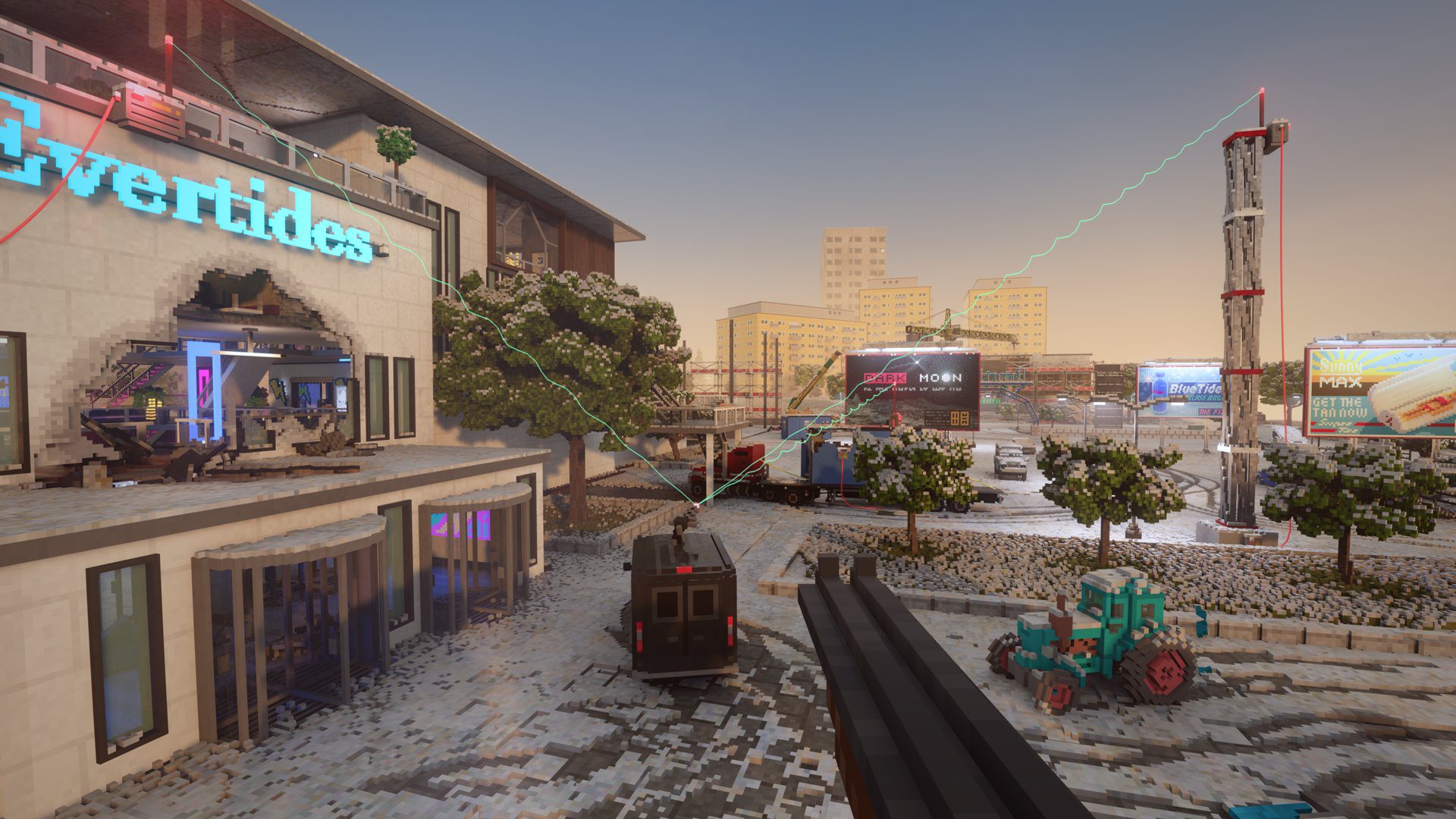
Teardown Multiplayer Modes range from the entire original campaign in co-op to straightforward competitive formats and community-made chaos. The core multiplayer framework supports up to 12 players, while the console launch also brings a large multiplayer-ready mod library that pushes the game well beyond a conventional set of playlists.
The easiest way to understand the update is to separate built-in multiplayer from community content. Tuxedo Labs provides campaign co-op, Sandbox and core competitive formats such as Deathmatch, Team Deathmatch and Capture the Flag. Multiplayer-compatible mods then add their own maps, rules and modes, including much stranger ideas that suit Teardown’s destruction engine.
Core Teardown Multiplayer Modes
The core Teardown Multiplayer Modes include Deathmatch, Team Deathmatch and Capture the Flag, giving players familiar competitive structures inside maps where walls, cover and routes can be destroyed. Treasure Thieves is another multiplayer mode introduced with the multiplayer build, adding an objective-focused option rather than pure elimination.
Because the environment is destructible, even familiar modes do not behave like static arena shooters. Cover can disappear, a route can be opened through a building and vehicles can turn a normal objective run into something much messier.
Campaign co-op
Campaign co-op is one of the biggest Teardown Multiplayer Modes because it makes the original base campaign playable with up to 12 people. The session uses the host’s save and unlocked missions, and only the host’s campaign progression advances.
Guests can still play missions they have not personally unlocked. The result is useful for both a proper shared run and a one-off night where somebody wants to show friends a later mission without forcing them through the campaign first.
Sandbox multiplayer
Sandbox sits at the opposite end of Teardown Multiplayer Modes from campaign objectives. It lets a group use the tools, vehicles and destructible spaces without needing to follow a timed heist route or win a competitive round.
Creative Mode is different and is not currently planned for multiplayer. Sandbox is therefore the built-in choice when the group simply wants to experiment or flatten a map together.
Community modes and Mod Pack 6
Community content dramatically expands Teardown Multiplayer Modes. The console launch includes more than 70 multiplayer-ready community mods across the wider curated library, with Mod Pack 6 adding 30 new multiplayer-compatible console mods.
Those additions include formats such as Prop Hunt, Battle Royale and cooperative zombie survival. They are community/mod content rather than the core built-in playlists, which is worth remembering when comparing what every fresh installation contains by default.
Maps and player limits
Teardown Multiplayer Modes can use the base-game map collection, dedicated multiplayer arenas and compatible community maps. The multiplayer build adds Splitfield Estate and Cratertown as new maps, while community creators can publish multiplayer-ready maps and modes using the updated scripting system.
Up to 12 players can join a session, although individual modded modes may be designed around fewer participants. Heavy physics, scripts and spawned objects can also make a smaller group sensible for demanding custom content.
Which mode should you start with?
For a first session, Teardown Multiplayer Modes are easiest to learn through Sandbox or a familiar competitive format before moving into a heavily modded lobby. Campaign co-op is the best choice if the group already understands Teardown’s heist structure and wants progression rather than quick rounds.
Our Teardown Multiplayer Maps guide covers where you can play, while Teardown Multiplayer Mods explains compatibility. First-party updates are available from the official Teardown website.
The multiplayer update keeps Teardown’s fully destructible simulation at the centre of the experience. More players do not turn the environments into static multiplayer maps: vehicles, structures and routes can still be changed during play, which is why hosting stability and clear coordination matter more here than they would in a conventional arena game.